Retinol and Ferulic Acid: Overcoming Formulation Instability and Skin Irritation
Stop trying to formulate with pure crystalline retinol. Pure retinol (98% assay) is highly unstable. It degrades rapidly when exposed to oxygen, light, and heat. Handling pure retinol powder on a factory floor is also a safety hazard for operators. Professional manufacturers almost exclusively use stabilized forms. These include retinol dissolved in soybean oil with BHT, or liposomal encapsulated retinol.
Formulators face two massive problems with retinoids: chemical degradation in the bottle and biological irritation on the skin. You can fix the first problem with liposomes. You can fix the second problem with ferulic acid.
Retinol causes retinization. This process accelerates cell turnover but triggers inflammatory cytokines. The skin gets red, dry, and peels. Consumers hate this. Ferulic acid acts as a biological buffer. It is a potent plant-derived antioxidant. It neutralizes the reactive oxygen species generated during skin inflammation. By pairing them, you get the collagen-boosting power of retinol without the severe epidermal barrier disruption.
Realistic Raw Material Specifications
We need to look at realistic raw material specifications. Do not source materials based on theoretical purity alone. Source based on formulation viability.
| Specification Parameter | Retinol (10% Liposomal Suspension) | Ferulic Acid (98% Natural Extract) |
|---|---|---|
| Appearance | Yellow opaque viscous liquid | White to off-white crystalline powder |
| Active Assay | 10.0% – 11.0% (HPLC) | NLT 98.0% (HPLC) |
| Solubility | Water dispersible | Poorly soluble in water. Soluble in Propanediol, DMI, Ethanol. |
| Optimal pH Range | 5.5 – 6.5 | 3.0 – 5.0 |
| Storage Temperature | 2°C – 8°C (Refrigerated) | Room temperature, away from light |
The Formulation Challenge: Targeted Solvent Systems
The real challenge is mixing them. You cannot just drop ferulic acid into a water phase. It is notoriously stubborn. If you heat water to 80°C, the ferulic acid will dissolve. But the moment your emulsion cools, it recrystallizes. You will end up with a gritty serum.
You need a targeted solvent system. A combination of Propanediol and Dimethyl Isosorbide (DMI) works exceptionally well.
Practical Framework: 0.3% Retinol + 0.5% Ferulic Acid Serum
- The Solvent Phase: Mix 0.5% Ferulic Acid with 5.0% Propanediol and 3.0% DMI. Heat gently until completely clear. Add this to your main water phase.
- The Emulsification: Form your standard O/W emulsion.
- The Cool-Down Phase: Wait until the batch temperature drops below 40°C. Never add retinol to a hot batch.
- The Active Addition: Add 3.0% of your Retinol (10% Liposomal) to achieve a final 0.3% active concentration.
Managing the pH Conflict
Now look at the pH conflict. Ferulic acid naturally drops the pH of your formula. If the pH goes below 4.5, your liposomal retinol structure might collapse. The retinol will leak out and degrade. You must buffer your final emulsion. Use Sodium Hydroxide or L-Arginine to adjust the final pH to exactly 5.5 to 6.0. This is the sweet spot where both molecules survive.
Market Compliance and Synergistic Efficacy
Let’s talk about market compliance. The European Union SCCS has tightened the rules. They strictly limit retinol to a maximum of 0.3% Retinol Equivalent for face creams. You cannot just pack 1.0% retinol into a bottle to get faster results anymore.
You have to formulate smarter. Ferulic acid bridges this efficacy gap. It provides its own anti-aging and brightening benefits. It inhibits tyrosinase activity. This tackles hyperpigmentation from a completely different pathway than retinol. The consumer gets a superior visible result from a legally compliant 0.3% retinol product.
We supply high-purity natural ferulic acid and stabilized retinol systems to cosmetic factories globally. We provide testing samples for your R&D team to run real-time stability protocols. Contact our technical team to request trial materials and specialized solvent guidelines.
References
- SCCS (Scientific Committee on Consumer Safety). (2022). Revision of the scientific opinion on Vitamin A (Retinol, Retinyl Acetate, Retinyl Palmitate).
- Zhai, H., et al. (2013). “Potential of ferulic acid in skin care applications.” Journal of Cosmetic Dermatology.
- Graf, E. (1992). “Antioxidant potential of ferulic acid.” Free Radical Biology and Medicine.
For Bulk Inquiries, Quotations, or Sample Requests:
🔒 Technical Documentation: Gain full access to TDS, MSDS, COA, and comprehensive Clinical Efficacy Reports.
🔬 Sample Procurement: Request a complimentary sample to verify the exceptional purity and performance of our active ingredients.
📞 Commercial Quotations: Contact us for customized pricing on bulk orders and high-purity specialized requirements.
Email: [email protected]
Why choose us
Huatai Bio provides a comprehensive portfolio of high-efficacy bulk cosmetic grade ingredients, empowering global brands to create next-generation skincare formulations. We combine nature’s potency with scientific precision to meet your most demanding wholesale procurement needs.
Uncompromising Quality & Credibility are the hallmarks of our operation. We ensure every bulk batch of our actives meets rigorous international standards, supported by a complete Technical Dossier. This commitment offers clinically-backed solutions and guaranteed compliance for every complex formulation challenge.
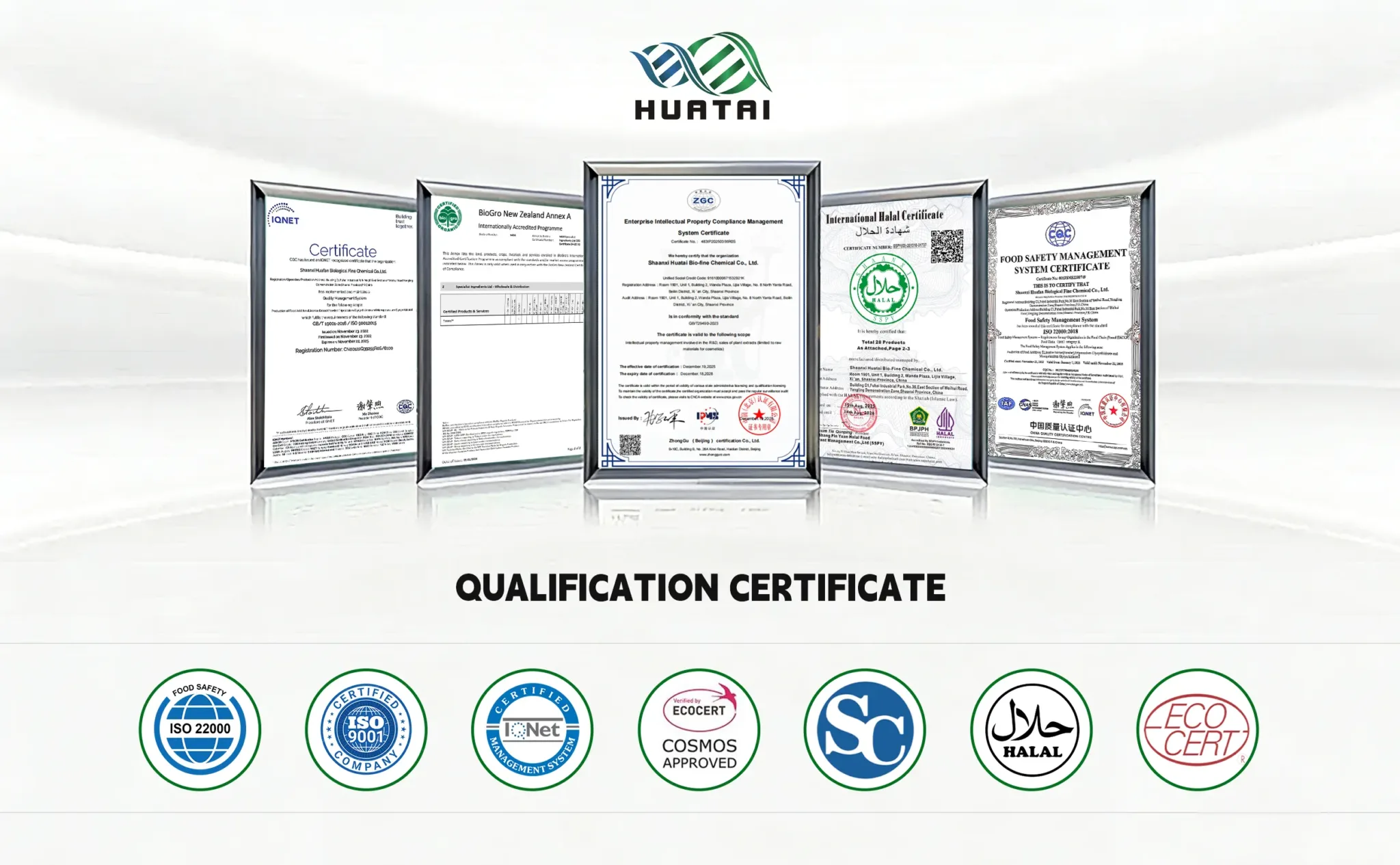
Certified Excellence & Supply Chain Integrity define our reliability as a premier wholesale partner. Our facilities and wholesale products are strictly verified by global standards, including COSMOS, ISO 9001/22000, and HALAL. As leading bulk suppliers, we maintain full transparency across our entire supply chain, providing a world-class foundation for your beauty innovations.
 English
 German
 Spanish
 French
 Japanese
 Korean
 Portuguese