Table of Contents
- 1. Molecular Architecture and Receptor Interaction
- 2. Kinetic Analysis of Tyrosinase Inhibition
- 3. Technical Specifications and COA Benchmarks
- 4. Formulation Dynamics: Overcoming Solubility Hurdles
- 5. Synergistic Matrix Protocols for Advanced Efficacy
- 6. Industry Trends and Regulatory Compliance
- 7. 8 High-Frequency Formulation FAQs (B2B Procurement)
- 8. Scientific Literature References
1. Molecular Architecture and Receptor Interaction
Extracted exclusively from the rhizomes of Glycyrrhiza glabra (Licorice Root), Glabridin is a highly lipophilic isoflavane derivative. Its specific molecular geometry allows it to penetrate the lipid bilayer of the stratum corneum with high efficiency. Unlike synthetic bleaching agents that induce cytotoxicity in melanocytes to halt pigment production, Glabridin operates through non-competitive tyrosinase inhibition. The structural hydroxyl groups at positions 2-prime and 4-prime on the isoflavan skeleton establish strong hydrogen bonds with the amino acid residues within the tyrosinase active site. This induces steric hindrance, physically blocking the catalytic conversion of L-DOPA to dopaquinone without destroying the melanocyte structure.
2. Kinetic Analysis of Tyrosinase Inhibition
Quantitative enzymatic assays reveal distinct kinetic profiles between various brightening agents. Rigorous in-vitro testing utilizing B16 murine melanoma cell lines indicates that high-purity Glabridin suppresses melanin synthesis with an IC50 value ranging between 0.1 to 1.0 ug/mL, strictly depending on the specific cellular assay environment and baseline compound purity.
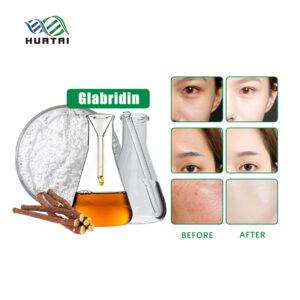
This contrast highlights distinct pharmacological pathways rather than categoric superiority: Kojic Acid acts primarily as a chelating agent for copper ions at the active site, while Glabridin utilizes spatial blockade. Furthermore, advanced stability testing on high-purity extracts reveals exceptional structural integrity, with the color difference variance (Delta E) remaining strictly below 1.0 during a 90-day accelerated stress test under standard emulsion parameters.
3. Technical Specifications and COA Benchmarks
Accurate raw material procurement demands strict adherence to defined physicochemical parameters. The following table outlines the standardized Certificate of Analysis (COA) benchmarks required for commercial-grade formulation.
| Analytical Parameter | Specification Benchmark | Testing Methodology / Notes |
|---|---|---|
| Chemical Identification | Glabridin | Isoflavane compound |
| CAS Number | 59870-68-7 | Standardized registry identifier |
| Purity Grade Spectrum | 10% to 99% (Powder) 1.0% to 5.0% (Liquid) | High-Performance Liquid Chromatography (HPLC) |
| Visual Appearance | White to reddish-brown fine powder | Tone varies precisely by extract purity percentage |
| Solubility Profile | Lipophilic (Insoluble in Water) | Soluble in Butylene Glycol, Propylene Glycol, and Lipids |
| Recommended Dosage | 0.01% to 0.5% (High Purity) | Based on rigorous dermal tolerance mapping |
| Heavy Metal Limits | Less than 10 ppm | Atomic Absorption Spectroscopy (AAS) |
| Microbiological Limits | Total Plate Count less than 100 cfu/g | Strict pathogen control (Negative for E. coli, Salmonella) |
| Formulation Stability | Delta E less than 1.0 | Proven resistance to UV-induced degradation |
| Standard Shelf Life | 24 Months | Store in sealed, cool, and light-deprived environments |
4. Formulation Dynamics: Overcoming Solubility and Phase Integration Hurdles
Glabridin’s intrinsic lipophilicity presents distinct physical chemistry challenges during emulsion development. Direct introduction into an aqueous phase will result in immediate crystallization, compromising both bioavailability and the structural integrity of the formulation.
For optimal integration into Oil-in-Water (O/W) emulsions, formulators must pre-dissolve the powdered extract in a suitable short-chain glycol (such as Butylene Glycol or Pentylene Glycol) or a compatible lipid carrier (such as Caprylic/Capric Triglyceride or Squalane) at elevated temperatures between 60 and 70 degrees Celsius. Once absolute visual transparency is achieved in the lipophilic premix, it must be introduced to the main emulsion vessel strictly during the cool-down phase below 45 degrees Celsius. This specific thermodynamic sequencing prevents the thermal degradation of the isoflavane structure and guarantees a homogeneous microscopic dispersion, eliminating the risk of phase separation over the commercial shelf life.
5. Synergistic Matrix Protocols for Advanced Efficacy
Strategic combination of active ingredients amplifies the disruption of the melanogenesis cascade across multiple cellular pathways. Clinical matrix testing yields the following verified protocols:
Glabridin + Niacinamide
This combination forms a dual-action regulatory matrix. Glabridin intercepts the initial oxidation of tyrosine within the melanosome, while Niacinamide halts the subsequent dendritic transfer of mature melanosomes to surrounding keratinocytes.
Glabridin + Ceramide NP
Clinical data confirms that UV exposure triggers inflammatory cytokines that accelerate pigmentation. Combining Glabridin with Ceramide NP achieves profound intracellular UV-damage repair alongside critical intercellular lipid barrier reconstruction.
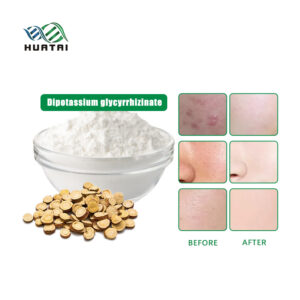
Glabridin + Glycyrrhizic Acid
Formulating Glabridin alongside Glycyrrhizic Acid at a clinically tested ratio of 1:2 yields a potent anti-inflammatory synergy. The Glycyrrhizic Acid downregulates the release of PGE2 and arachidonic acid, lowering the baseline cellular inflammation that serves as a primary catalyst for post-inflammatory hyperpigmentation (PIH).
6. Industry Trends and Regulatory Compliance
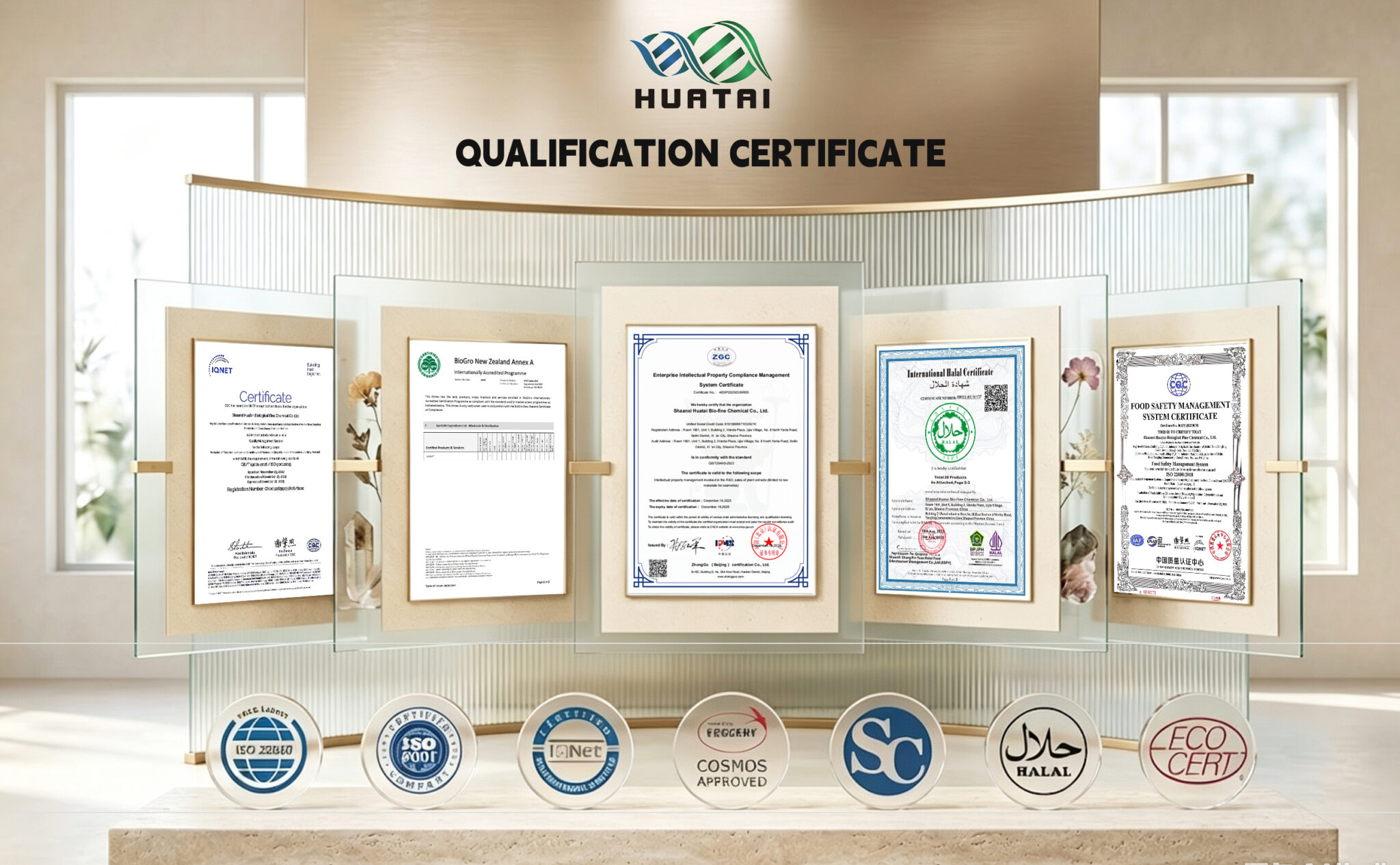
The transition toward highly functional, botanical-derived compounds is aggressively reshaping supply chain standards. Regulatory bodies globally are enforcing tighter restrictions on synthetic bleaching agents due to documented dermal sensitization risks. Consequently, laboratories prioritize bioactive ingredients featuring comprehensive toxicological dossiers. Sourcing extracts that comply with ISO 9001, ISO 22000, and HALAL standards provides brand owners with an unobstructed pathway for international cosmetic registration. As Clean Beauty mandates expand, the demand for naturally derived, COSMOS-aligned botanical extractions dictates the trajectory of modern dermatological research and development.
7. 8 High-Frequency Formulation FAQs (B2B Procurement)
Q1: What is the standard purity specification for cosmetic-grade Glabridin?
Formulators typically select between 40% and 99% purity grades. The 99% specification, appearing as a highly refined white powder, is strictly utilized for premium clinical serums, while the 40% variant is engineered for broad-spectrum lotions and barrier creams requiring strong antioxidant support.
Q2: Is Glabridin water-soluble and how should it be incorporated into emulsions?
It is strictly lipophilic and entirely insoluble in pure water. It must be pre-solubilized in cosmetic glycols or integrated directly into the heated oil phase prior to emulsification to prevent molecular crystallization.
Q3: What is the recommended usage rate for skin brightening formulations?
Depending on the purity grade, optimal clinical efficacy is achieved at concentrations ranging from 0.01% to 0.5% for high-purity powders. Liquid variants are generally dosed between 1.0% and 5.0% within the final formulation matrix.
Q4: How does this active interact with hyper-reactive or compromised skin profiles?
Unlike synthetic peeling acids that induce micro-exfoliation and disrupt the acid mantle, this isoflavane operates purely at the enzymatic level. It presents zero risk of acid-induced stinging, making it a critical active for sensitive skin protocols.
Q5: Can it be combined with active ingredients like Niacinamide or Vitamin C?
Yes. It exhibits high chemical compatibility with both Niacinamide and stabilized Vitamin C derivatives (such as Ascorbyl Glucoside). These combinations target the melanogenesis cascade at different cellular stages, multiplying overall formula efficacy.
Q6: What technical documentation is required for wholesale procurement?
Professional botanical extraction suppliers must provide batch-specific Certificates of Analysis (COA), Technical Data Sheets (TDS), Material Safety Data Sheets (MSDS), and comprehensive heavy metal and microbiological limit testing reports for regulatory compliance.
Q7: What is the Minimum Order Quantity (MOQ) for bulk commercial purchases?
Standard industrial operations typically support an agile MOQ starting at 1kg for high-purity powdered actives, accommodating both bespoke independent brands and large-scale multinational manufacturing runs.
Q8: Are testing samples available for independent formulation laboratories?
Reliable manufacturers consistently supply free analytical testing samples directly to research and development departments. This allows cosmetic chemists to perform critical solubility, heat tolerance, and phase stability stress tests before committing to large-scale procurement.
8. Scientific Literature References
- Yokota, T., et al. (1998). “The inhibitory effect of glabridin from licorice extracts on melanogenesis and inflammation.” Pigment Cell Research, 11(6), 355-361.
- Simmler, C., Pauli, G. F., & Chen, S. N. (2013). “Phytochemistry and biological properties of glabridin.” Fitoterapia, 90, 160-184.
- D’Mello, S. A., Finlay, G. J., Baguley, B. C., & Askarian-Amiri, M. E. (2016). “Signaling Pathways in Melanogenesis.” International Journal of Molecular Sciences, 17(7), 1144.
- Smit, N., Vicanova, J., & Pavel, S. (2009). “The Hunt for Natural Skin Whitening Agents.” International Journal of Molecular Sciences, 10(12), 5326-5349.
 English
 German
 Spanish
 French
 Japanese
 Korean