



Retinol
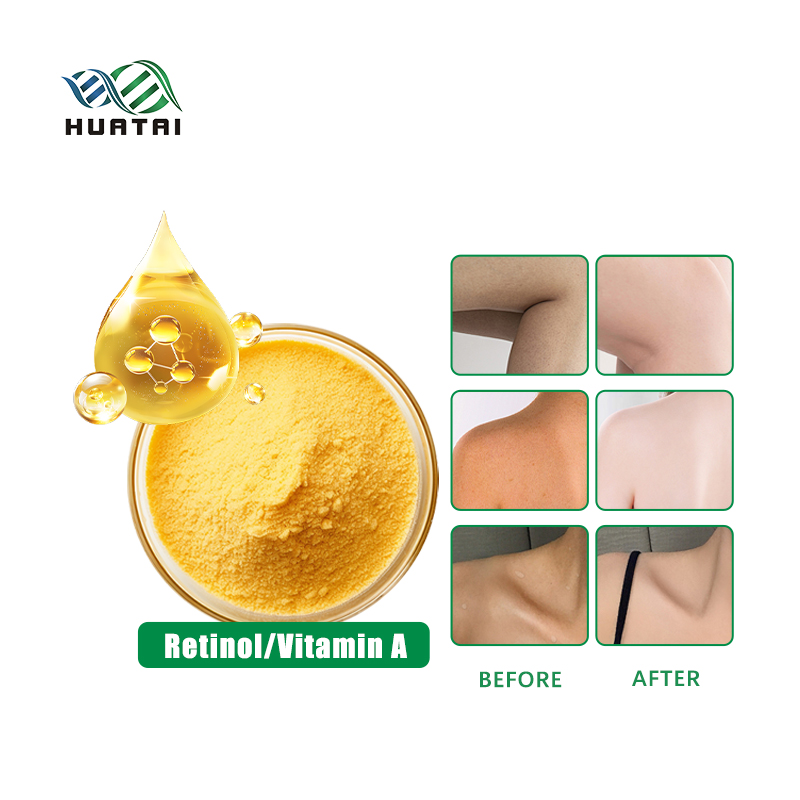
Retinol, a pure form of Vitamin A, is the most scientifically proven and widely recognized ingredient for skin renewal and anti-aging. It works by accelerating cell turnover and stimulating collagen production, dramatically reducing the appearance of fine lines, wrinkles, and acne. Its profound efficacy makes it the gold standard, though it requires specialized formulation due to its extreme sensitivity to light, air, and heat.

| INCI Name | Retinol |
|---|---|
| CAS No. | 68-26-8 |
| Purity | ≥98% (Often supplied as a 10% solution in carrier oil) |
| Appearance | Yellow viscous oil or crystals |
| Core Function | Anti-aging, Anti-wrinkle, Collagen Synthesis, Anti-acne, Skin Renewal. |
Direct Factory Supply
Factory-direct supply ensures high-purity active ingredients with full batch-to-batch consistency.
Formulation Support
Custom concentrations, solvent options, and professional technical guidance for your formulas.
Efficacy & Testing
Complete COA, HPLC testing charts, INCI documentation, and Safety Data Sheets (MSDS).
Global Compliance
ISO22000 & COSMOS certified manufacturing, fully compliant with EU and US FDA regulations.
Are Your Retinol Products Losing Potency? Stop Fighting Instability and Start Delivering Clinical-Grade Results with Ultra-Pure, Stabilized Retinol
In the luxury skincare sector, Retinol is the gold-standard anti-aging active, yet it remains the formulator’s greatest challenge. Crude, sub-standard Retinol oxidizes rapidly, discolors formulas, and loses efficacy before it ever reaches the consumer, leading to high return rates and eroded brand equity. As your premier high-purity natural cosmetic active ingredients wholesaler, we provide the solution: high-purity, stabilized Retinol engineered for the most demanding luxury formulations. Our refined ingredient ensures maximum bio-availability and cellular renewal, empowering your brand to deliver visible anti-aging results while maintaining the uncompromising stability that elite markets demand.
🚀 Core Clinical & Laboratory Proof: Efficacy that Redefines Expectations
Build your brand’s prestige on performance data that validates a professional-grade cellular strategy:
Gene-Modulation Mastery: Confirmed to regulate the expression of over 50 specific genes within human skin cells, fundamentally focusing on the upregulation of collagen production and the thickening of the epidermal layer.
Decades of Clinical Validation: Backed by the industry’s most extensive dermatological evidence, demonstrating unmatched capabilities in reversing photo-damage, refining skin texture, and managing complex keratinization.
≥ 98.0% Purity for Maximum Formulation Control: Our ultra-pure process guarantees a potent active that is free from the residual solvents and impurities that trigger formula darkening and undesirable sensory drift.
🔬 Core Specifications & Technical Parameters
To ensure seamless integration for your formulation engineers and absolute ease of copy-pasting into your internal specification sheets, our critical product data is standardized below:
Product Parameter Specification Limit / Guideline
INCI Name Retinol Purity ≥ 98.0% Appearance Yellow viscous oil or crystals Recommended Dosage 0.05% – 1.0% Mechanism of Action Nuclear Receptor (RAR/RXR) Binding Solubility Oil-soluble; use inert carrier/encapsulation Optimal Formulation pH 5.5 – 6.0
💡 Golden Formula Inspirations: The Formulator’s Blueprint
Skip the R&D trial-and-error. Our high-purity Retinol is designed to be the core of your “Hero” products when paired with our stabilization expertise:
The “Structural Regeneration” Matrix (Retinol + Sodium DNA): The ultimate professional anti-aging system. Retinol accelerates cellular turnover, while Sodium DNA provides the structural building blocks for long-term dermal thickness and repair.
The “Radiance-Refinement” Protocol (Retinol + Vitamin C Derivatives): A comprehensive nightly treatment plan. Retinol manages surface texture and fine lines, while stabilized Vitamin C works on surface luminosity and antioxidant protection.
The “Sensitive-Renewal” Complex (Retinol + Bisabolol): Designed for high-end “Retinol for Beginners” lines. Bisabolol works synergistically to neutralize the inflammatory pathway often triggered by Retinol, allowing for higher active concentrations with zero consumer discomfort.
🛡️ Unwavering Quality Assurance & Global Regulatory Confidence
When formulating with the industry’s most potent active, regulatory compliance is your foundation for success. Our materials are strictly certified and fully documented:
ISO9001
ISO22000
COSMOS
HALAL
IQNET
⚡ Take Immediate Action to Lead the High-Performance Market
Don’t let unstable raw materials compromise the prestige and performance of your anti-aging lines. Partner with the industry’s most reliable supplier to ensure every bottle you ship maintains its clinical potency.
Ready to revolutionize your Retinol formulations? Your next formulation breakthrough starts with a higher standard of purity. Visit our dedicated technical portal at natural-huatai.com to secure your comprehensive technical dossier (TDS, MSDS, COA) today. Immediately request your high-purity, laboratory-grade free samples for in-house stability testing and witness the difference that professional-grade purity makes.
Don’t just offer an anti-aging promise—deliver a scientifically validated cellular transformation. Reach out to our expert procurement team for a customized bulk quote now!
 English
 German
 Spanish
 French
 Japanese
 Korean