Let’s address a major blind spot in cosmetic R&D. Relying purely on mushroom tyrosinase assays for whitening claims is scientifically reckless. Glabridin physically downregulates β-catenin protein expression. This direct action suppresses MITF (Microphthalmia-associated transcription factor). Dendrite formation in melanocytes simply stops. Melanin cannot transfer to keratinocytes. [Pigment Cell Research: The inhibitory effect of glabridin from licorice extracts on melanogenesis and inflammation – https://pubmed.ncbi.nlm.nih.gov/9870547/]
High-concentration single-agent loading often fails in clinical trials. Current formulation science prioritizes exact enzymatic targeting. Why? Competitive tyrosinase inhibition requires precise enzyme-substrate binding affinities. A synergistic matrix of Glabridin, Niacinamide, and stable Vitamin C derivatives creates an optimal blockade. It effectively mitigates UVA-induced pigmentation. The physical mechanism relies on direct copper ion chelation within the tyrosinase active site.
Hard Data: Corrected Physicochemical Specifications
Formulators know the formulation headache. You drop lipophilic extracts into high-water phases. They immediately crystallize. Glabridin exhibits near-zero water solubility. It precipitates rapidly from common solvents upon aqueous dilution. This physical reality ruins shelf life. It also artificially underestimates whitening efficacy in basic in vitro assays. [International Journal of Cosmetic Science: Overestimated cytotoxicity and underestimated whitening efficacy of glabridin – https://pubmed.ncbi.nlm.nih.gov/32745269/]
We must rely on absolute parameters. Commercial extracts demand strict analytical precision. A common industry error is assuming all Glabridin grades are white powders. They are not. Below are the corrected, rigorous B2B benchmarks mapping 40% and 90% purity grades.
| Parameter / Assay | Glabridin 40% (Cosmetic Grade) | Glabridin 90% (High Purity) | Analytical Method |
|---|---|---|---|
| Appearance | Light yellow to brownish-yellow powder | White to off-white crystalline powder | Visual / Organoleptic |
| Assay (HPLC) | ≥ 40.0% | ≥ 90.0% | HPLC (230 nm UV detection) |
| Solubility | Insoluble in water; Soluble in PG, BG | Insoluble in water; Soluble in Ethanol, BG | Pharmacopoeia standard |
| Microbiological | ≤ 1000 cfu/g | ≤ 100 cfu/g | AOAC / USP |
Rigorous Tyrosinase Inhibition Benchmarks
Let’s look at the actual cellular numbers. Comparing Kojic Acid to Glabridin requires mammalian cell data, not just fungal enzymes.
| Active Ingredient | IC50 Value (Mammalian Cell) | Primary Mechanism of Action | Clinical Stability |
|---|---|---|---|
| Glabridin | 0.22 – 0.45 µM | Competitive inhibition, MITF suppression | High (pH 5.0 – 7.0) |
| Kojic Acid | > 15.0 µM | Copper chelation in active site | Low (Oxidizes rapidly) |
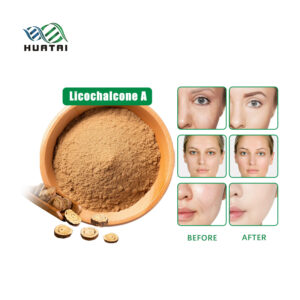
| Licochalcone A | 1.5 – 2.5 µM | Tyrosinase inhibition, anti-inflammatory | High (Excellent heat stability) |
The data dictates the clinical dosage. Testing matrices using human melanocyte cultures (MNT-1) confirm zero toxicity below 5 µM. HaCaT cells tolerate up to 10 µM without morphological changes. [Journal of Dermatological Science: Glabridin Inhibits Melanogenesis – https://pubmed.ncbi.nlm.nih.gov/30591325/] What does this mean for R&D? An exceptionally high safety margin. You can formulate for continuous topical application while heavily suppressing intracellular tyrosinase activity.
Modern Matrix Synergies & Delivery
Liquid serums absolutely demand encapsulation. Cyclodextrin complexes or liposomal systems are non-negotiable for aqueous stability. Transdermal innovations are moving forward fast. Formulators now utilize nano-emulsions to physically transport Glabridin deep into the dermis. The lipophilic molecular structure remains perfectly intact during penetration.
- Glabridin (0.05%) + Bakuchiol (1.0%): Pure dual-action synergy. Targets both photoaging and recalcitrant melasma. Bakuchiol structurally supports the extracellular matrix. Glabridin handles localized hyperpigmentation. You bypass synthetic retinoid irritation entirely.
- Glabridin (0.1%) + Ascorbyl Glucoside (AA2G) (2.0%): A highly stable matrix. Pure L-Ascorbic acid mandates an acidic pH (below 3.5). That destroys Glabridin. AA2G allows formulation at pH 6.0, preserving the isoflavane backbone while delivering sustained Vitamin C release.
- Glabridin + Niacinamide (4.0%): A strict dual-pathway melanin blockade. Glabridin halts tyrosinase at the melanocyte source. Niacinamide intercepts melanosome transfer directly at the keratinocyte barrier.
Kinetic Stability & Degradation Reality
Thermal and photodegradation kinetic studies reveal a harsh truth. Glabridin hates alkaline shifts. You must strictly maintain a bulk formula pH of 5.0 to 7.0. Formulations exceeding pH 8.0 will oxidize rapidly. Your pristine cosmetic base will turn visibly brown within weeks. Photostability is another critical hurdle. Prolonged exposure to UV radiation shatters the molecular backbone. Always specify UV-protective packaging. Amber glass or opaque airless pumps are mandatory for commercial viability.
FAQ: High-Frequency Sourcing & Formulation Diagnostics
1. What is the actual color difference between 40% and 90% Glabridin?
This is a critical QC checkpoint. 40% Glabridin is a light yellow to brownish-yellow powder due to the presence of other licorice flavonoids. 90% Glabridin is highly purified. It appears as a white to off-white crystalline powder. If a supplier offers pure white 40% Glabridin, the specification is highly suspect.
2. How do formulators stop Glabridin recrystallization in water bases?
Solvent polarity shifts cause these microscopic crystals. Staged temperature reduction is required. Better yet? Use chemical encapsulation. Hydroxypropyl-beta-cyclodextrin complexes physically shield the lipophilic molecules from the continuous water phase.
3. What is the exact pH range for Glabridin emulsion stability?
Keep it strictly between 5.0 and 7.0. Dropping below pH 3.5? The molecule begins to degrade. Pushing above pH 8.0? It triggers immediate oxidative browning in the bulk formula.
4. Can you formulate Glabridin directly with pure Vitamin C?
No. Pure L-Ascorbic Acid requires a pH below 3.5 to penetrate the stratum corneum. This highly acidic environment destabilizes Glabridin. Swap L-Ascorbic Acid for stable, pH-neutral derivatives. Use Magnesium Ascorbyl Phosphate (MAP) or AA2G instead.
5. What is the clinical usage rate in commercial skin whitening products?
Less is more in enzymatic inhibition. For the 40% cosmetic grade, dose between 0.05% and 0.2%. For the 90% clinical grade, restrict usage to 0.01% – 0.05%. You hit peak efficacy while maintaining a massive toxicological safety margin.
6. How does Glabridin’s IC50 for tyrosinase actually compare to Kojic Acid?
In mammalian cell assays, Glabridin’s IC50 sits between 0.22 and 0.45 µM. It is exponentially more powerful than Kojic Acid (which typically requires >15 µM for similar in vitro inhibition). You secure superior depigmentation without the cellular cytotoxicity associated with high-dose Kojic Acid.
7. Does Glabridin trigger phototoxicity under UV exposure?
Zero phototoxicity. It actually mitigates UV-induced erythema via established anti-inflammatory pathways. It is fully compliant with EU REACH and US FDA cosmetic regulations (INCI: Glycyrrhiza Glabra Root Extract).
8. What solvents are best for pre-dissolving Glabridin powder?
Expect zero water solubility. You must use 1,3-Butylene Glycol (BG), Propylene Glycol (PG), or PEG-400. For aqueous serums, pre-dissolve the powder in BG at 40-50°C prior to emulsification. Otherwise, the active phase will immediately crash out of the solution.
 English
 German
 Spanish
 French
 Japanese
 Korean