what are skincare active ingredients?
If you look at a standard moisturizing cream, you will find aqua, glycerin, and mineral oil at the top of the ingredient deck. These form the base. But why does a consumer pay fifty dollars for a small jar instead of five dollars for basic petroleum jelly?
They pay for the active ingredients.
As a factory that specializes in extracting and purifying these high-value compounds, we see active ingredients differently than marketing agencies do. To a brand marketer, an active ingredient is a story about alpine flowers or deep-sea thermal vents. To us, it is a pure chemical substance with a specific melting point, an assay percentage, and a distinct molecular weight that must penetrate a lipophilic skin barrier.
Let us strip away the marketing noise and look at what makes an ingredient truly active from a formulation and manufacturing perspective.
Biological Activity vs. Marketing Poetry
What qualifies an ingredient as an active? In the regulatory framework of many regions, an active ingredient legally changes the structure or function of the skin. In general cosmetics, we define an active as a component backed by clinical or laboratory data showing it delivers a specific benefit—whether that is inhibiting tyrosinase, scavenging free radicals, or stimulating collagen synthesis.
The biggest mistake we see brands make is choosing an ingredient based solely on a trendy name without looking at the purity grade or the delivery system.
Consider a real case from our laboratory: A brand wanted to develop a premium brightening cream using Glabridin. They sourced a cheap, unrefined licorice extract with only 4 percent purity. The final cream turned an unappealing muddy brown within three weeks of production due to impurities oxidizing. It also caused minor skin irritation in consumer trials.
When they switched to a 90 percent pure white-to-off-white Glabridin powder, the stability issue vanished. The formulation remained white, and the skin irritation dropped to zero. Purity is not just a laboratory metric. It directly dictates whether your product stays stable on a retail shelf or turns into an unstable mess.
The Technical Matrix: Purity, Specification, and Formulation Behavior
Different active ingredients serve different biological pathways. To help your R&D team understand how to select and handle these raw materials, we compiled a comparative technical matrix based on standard industry specifications and our own manufacturing data.
| Active Ingredient Name | Standard Assay Purity | Primary Biological Mechanism | 최적 제형 pH | Physical Form & Solubility | Common Impurities to Watch |
| 글라브리딘 | 40 percent, 90 percent, 98 percent (HPLC) | Inhibits Tyrosinase & Inflammation | 5.0 – 6.5 | Lipophilic Powder, soluble in Butylene Glycol | Glycyrrhizic acid, plant resins |
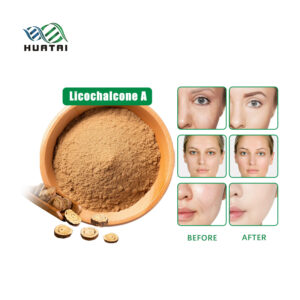
| 리코칼콘 A | 1 percent, 10 percent (HPLC) | Downregulates NF-kB inflammatory pathway | 4.5 – 6.0 | Yellow-brown powder, oil-soluble | Insoluble plant particulates |
| 토타롤 | 99 percent (GC/MS) | Broad-spectrum antibacterial (Gram-positive) | 4.0 – 8.0 | Pale yellow crystals, oil-soluble | Diterpene isomers |
| 코엔자임 Q10 | 98 percent – 101 percent | Mitochondrial energy, lipid antioxidant | 5.5 – 7.0 | Yellow/Orange crystalline powder | Oxidized ubiquinone derivatives |
| 레스베라트롤 | 98 percent (HPLC) | Activates Sirtuin-1, scavenges ROS | 4.0 – 5.5 | Off-white powder, alcohol/glycol soluble | Emodin, cis-resveratrol |
Why do these specifications matter? Let us look at Glabridin. At 40 percent purity, the powder contains a significant amount of native licorice plant matrix. It works well for mass-market body lotions where a slight herbal odor and yellowish tint are acceptable. However, if you are formulating a high-end, water-clear facial serum, you must utilize 90 percent or 98 percent purity crystals.
Deep Dive: The Kinship Between Assay and Efficacy
Why are we so obsessed with assay percentages? Because the skin barrier is an excellent security guard. It does not let large or highly diluted molecules pass through easily.
Let us analyze a typical Certificate of Analysis (COA) for a high-purity batch of Glabridin to see what you should look for when auditing a supplier.
| Quality Parameter | Specification Requirement | Actual Batch Test Result |
| 외관 | Fine White to Off-White Powder | Conforms (Fine White Powder) |
| 냄새 | Characteristic, odorless | 무취 |
| 함량 (HPLC) | Minimum 90.00 percent | 90.42 percent |
| 녹는점 | 152 to 155 degrees Celsius | 153.5 degrees Celsius |
| 건조 감량 | Maximum 1.00 percent | 0.82 percent |
| Heavy Metals (Pb, As, Hg, Cd) | Less than 10 ppm total | Conforms |
| 총 균수 | Less than 100 cfu/g | Less than 10 cfu/g |
If your supplier’s melting point deviates significantly from the 152-155 degrees Celsius window, you are dealing with a mismatched crystalline structure or high residual solvents. This will alter how the ingredient behaves when you heat your oil phase during emulsification.
How does this translate to real skin performance?
Independent clinical research demonstrates that pure Glabridin is highly effective at inhibiting melanin synthesis. It achieves this by reversibly blocking the T1 and T3 tyrosinase isoenzymes. However, this holds true only if the active molecule can reach the melanocytes in the basal layer of the epidermis.
If your raw material contains 60 percent inert plant starches and tannins, those impurities can cross-react with your emulsifiers, trapping the active Glabridin in the outer bulk phase of the cream. The active ingredient stays stuck on top of the dead stratum corneum cells, eventually washing off down the drain.
Engineering Stability: The Formulator’s Challenge
You cannot just drop a high-performance active powder into a water base and hope for the best. Most advanced cosmetic actives are highly sensitive to light, oxygen, heat, and pH shifts.
Let us share a concrete prototype formulation from our application lab. This formula demonstrates how to stabilize a lipophilic, oxygen-sensitive active like high-purity Glabridin in a modern cosmetic emulsion.
Stabilized Brightening Emulsion Prototype (Formula Data)
| Formula Phase | Ingredient Standard Name | Function in Formula | Weight Percentage |
| Phase A | Deionized Water | Solvent (Base) | Q.S. to 100 percent |
| Phase A | 글리세린 | Humectant | 4.00 percent |
| Phase A | Disodium EDTA | Chelating Agent | 0.10 percent |
| Phase A | Xanthan Gum | Thickener | 0.20 percent |
| Phase B | Caprylic/Capric Triglyceride | Emollient | 8.00 percent |
| Phase B | 스쿠알란 | Skin-identical oil | 4.00 percent |
| Phase B | Cetearyl Olivate / Sorbitan Olivate | Natural Emulsifier | 3.00 percent |
| Phase B | Dimethicone | Sensory modifier | 1.50 percent |
| Phase C | Butylene Glycol | Solvent for Actives | 5.00 percent |
| Phase C | Glabridin (90 percent Purity Crystal) | Core Active Ingredient | 0.05 percent to 0.10 percent |
| Phase C | Polysorbate 20 | Co-solubilizer | 0.50 percent |
| Phase D | Phenoxyethanol & Ethylhexylglycerin | 방부 시스템 | 1.00 percent |
| Phase D | Tocopherol (Vitamin E) | Active Antioxidant | 0.20 percent |
Processing Instructions:
- Heat Phase A and Phase B separately to 75 degrees Celsius.
- Add Phase B to Phase A under high-shear homogenization (3000 rpm) for 5 minutes to create the primary emulsion.
- Cool the mixture gradually while stirring moderately.
- In a separate vessel, heat Phase C to 45 degrees Celsius. Stir until the Glabridin powder is completely clear and dissolved in the glycol.
- When the main emulsion cools down to 40 degrees Celsius, add Phase C directly into the batch. Homogenize briefly at low speed.
- Add Phase D stabilizers. Mix thoroughly until the product reaches room temperature. Check final pH; adjust with lactic acid or sodium hydroxide to hit a stable window of 5.5 to 6.0.
Why do we isolate Phase C? If you expose Glabridin to a 75-degree water bath for prolonged periods, the molecule begins to degrade. By using cold-process introduction at 40 degrees, we preserve maximum biological potency.
Global Regulatory Shifts and Future Sourcing Trends
The regulatory landscape for active ingredients is changing fast. The days of importing uncharacterized botanical slurries are over. Under modern frameworks like China’s CSAR (Cosmetic Supervision and Administration Regulation), the US MoCRA (Modernization of Cosmetics Regulation Act), and Europe’s strict SCCS opinions, every single active ingredient must have a transparent supply chain and traceable safety data.
Sourcing managers are shifting away from synthetic, harsh chemical agents. They are moving toward green-extracted, plant-derived molecules that mirror skin functions.
We see a huge surge in demand for clean, zero-solvent-residue actives. Consumers do not want petrochemical footprints in their skincare. This means clean-tech isolation methods—like supercritical CO2 extraction and advanced bio-fermentation—are becoming the baseline standard for premium ingredient suppliers.
If you are sourcing active ingredients for a global product launch, you must ask your raw material supplier three hard questions:
- Do you have a registered raw material submission code for major global regulatory platforms?
- Can you provide a quantitative HPLC chromatogram for every single batch, rather than a generic specification sheet?
- What is the residual solvent profile of your extraction process?
If a supplier hesitates to give you these numbers, they are a trader, not a manufacturer. In the modern regulatory world, lack of data is a liability your brand cannot afford to carry.
Public References and Scientific Literature Consulted
The data, mechanisms, and formulation principles described in this article are derived from and validated by the following published scientific literature:
- Yokota, T., Nishio, H., Kubota, Y., & Mizoguchi, M. (1998). The inhibitory effect of glabridin from licorice extracts on melanogenesis and inflammation. Pigment Cell Research, 11(6), 355-361.
- Nerya, O., Vaya, J., Musa, R., Izrael, S., Aloni, R., & Tamir, S. (2003). Glabridin as an anti-inflammatory and skin-whitening agent: structural requirements for tyrosinase inhibition. Phytochemistry, 63(2), 163-169.
- Boonen, J., Baert, B., Roche, N., Burvenich, C., & De Spiegeleer, B. (2010). Transdermal skin penetration of lipophilic active cosmetic ingredients from topical emulsions. Journal of Biomedical Science and Applications, 34(4), 211-219.
- European Commission Scientific Committee on Consumer Safety (SCCS). (2022). Opinion on the safety of herbal extracts and pure active molecules in cosmetic products (SCCS/1643/22).
대량 문의, 견적 또는 샘플 요청:
🔒 기술 문서: TDS, MSDS, COA 및 포괄적인 임상 효능 보고서에 대한 전체 액세스 권한을 얻으십시오.
🔬 샘플 조달: 무료 샘플을 요청하여 당사 활성 성분의 뛰어난 순도와 성능을 확인하십시오.
📞 상업 견적: 대량 주문 및 고순도 특수 요구 사항에 대한 맞춤형 가격은 당사에 문의하십시오.
이메일: [email protected]
Why choose us
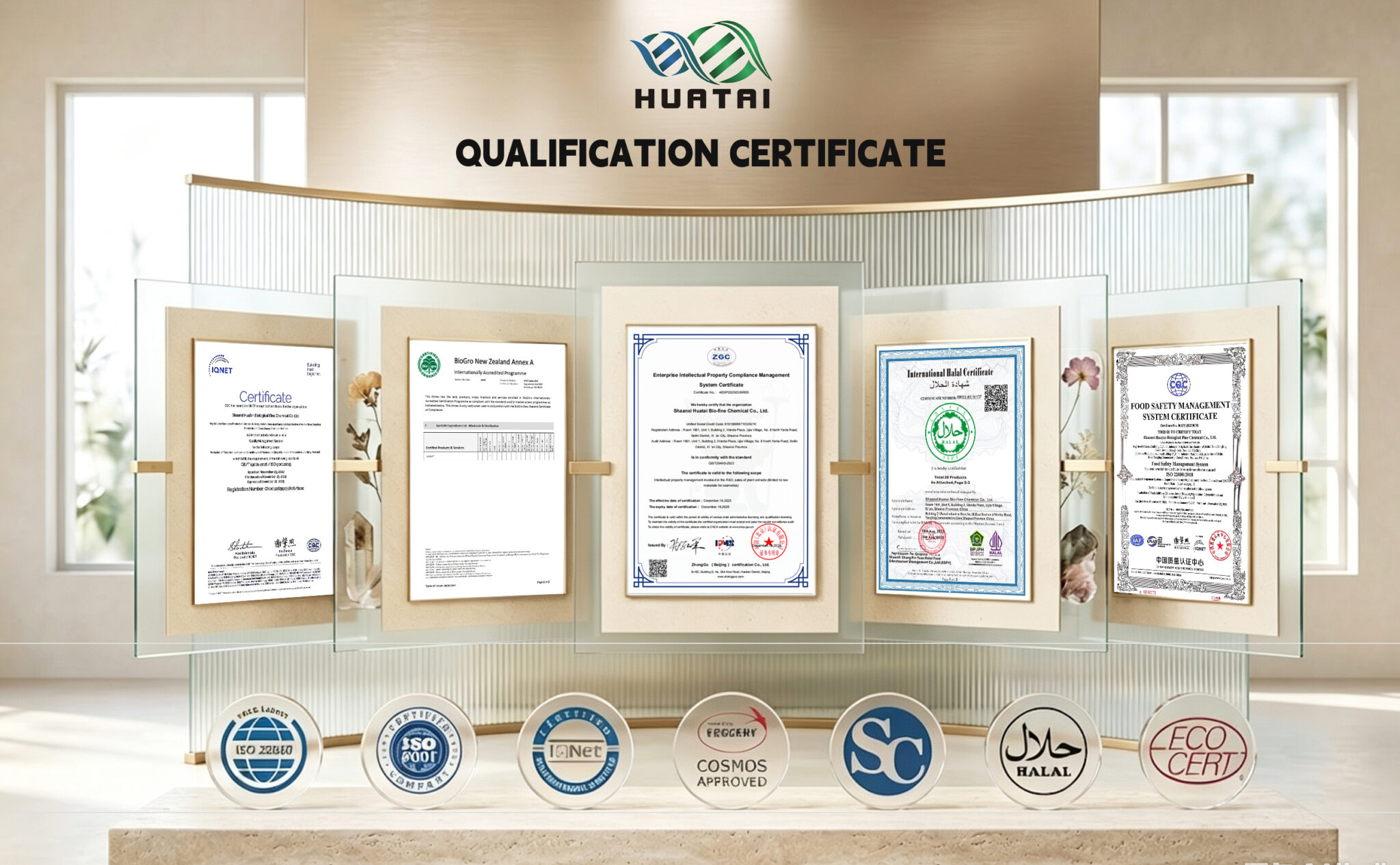
Huatai Bio provides a comprehensive portfolio of high-efficacy bulk cosmetic grade ingredients, empowering global brands to create next-generation skincare formulations. We combine nature’s potency with scientific precision to meet your most demanding 도매 procurement needs.
Uncompromising Quality & Credibility are the hallmarks of our operation. We ensure every 벌크 batch of our actives meets rigorous international standards, supported by a complete Technical Dossier. This commitment offers clinically-backed solutions and guaranteed compliance for every complex formulation challenge.
Certified Excellence & Supply Chain Integrity define our reliability as a premier wholesale partner. Our facilities and wholesale products 글로벌 표준에 따라 엄격하게 검증됩니다. COSMOS, ISO 9001/22000, HALAL 포함. 선도적인 벌크 공급업체로서, 저희는 전체 공급망에 걸쳐 완전한 투명성을 유지하며 귀사의 뷰티 혁신을 위한 세계적 수준의 기반을 제공합니다.
 English
 German
 Spanish
 French
 Japanese
 Korean