
Botanical extracts often present formulation challenges. Formulators face cloudy serums and unexpected color shifts. Totarol, a diterpene extracted from Podocarpus totara heartwood, is no exception. It delivers exceptional anti-inflammatory and antimicrobial results. But formulating with it demands precise physical chemistry. We are an active ingredient manufacturer. We rely on beaker data, not marketing claims. Let us examine the rigorous chemical and biological data.
Antimicrobial Efficacy: Precise MIC Profiling
Targeting acne requires specific bacterial inhibition. We measure this via Minimum Inhibitory Concentration (MIC). Lower values indicate higher potency. Generalizing “antibacterial” claims is unscientific. We must separate Gram-positive and Gram-negative efficacy.
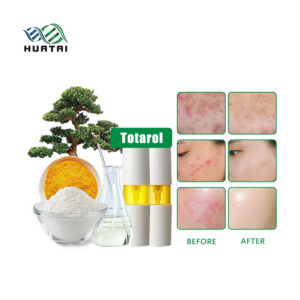
Here is the exact MIC data for Totarol against common dermal and environmental pathogens:
| Microorganism | Gram Type | MIC (μg/mL) |
|---|---|---|
| Cutibacterium acnes | Positive | 0.5 – 1.5 |
| Staphylococcus aureus | Positive | 1.0 – 2.0 |
| Streptococcus mutans | Positive | 2.0 – 4.0 |
| Enterobacter aerogenes | Negative | > 100.0 |
| Escherichia coli | Negative | > 100.0 |
The data reveals a stark contrast. Totarol disrupts Gram-positive bacterial cell membranes at extremely low concentrations. You only need 0.1% in a formula for clinical efficacy. However, its efficacy drops against Gram-negative strains like Enterobacter aerogenes. This requires formulators to pair Totarol with Gram-negative targeted preservatives for full-spectrum product protection.
Antioxidant Capacity: Standardized IC50 Metrics
Acne pathogenesis involves lipid peroxidation. We measure antioxidant capacity using the DPPH radical scavenging assay. We must specify the solvent, as Totarol’s lipophilicity skews water-based assays. Using an ethanol-based DPPH assay, we find the IC50 (concentration for 50% radical scavenging).
| Antioxidant | IC50 (μg/mL) |
|---|---|
| Trolox (Standard) | 10.5 |
| Totarol | 14.8 |
| BHT (Synthetic) | 18.2 |
Totarol performs close to pharmaceutical standards. It prevents sebum oxidation. This stops comedone formation before inflammation begins.
Physical Chemistry: Color and Crystallization
Many suppliers ignore physical limitations. Pure Totarol (98%+) is a pale yellow to light amber crystalline powder. A 0.1% usage rate gives creams an off-white tint. Serums will look like pale straw. Do not fight this color. Use it as proof of active botanical presence.
Crystallization is the primary failure point. Totarol is highly lipophilic. It repels water. Weak solvent systems cause precipitation. Temperature drops during shipping will form needle-like crystals. Patented encapsulation technologies exist. They are often unnecessary and inflate raw material costs. Standard glycols provide perfect stability.
Product Data Specifications (Cosmetic Grade Totarol 98%)
As a primary manufacturer, we rely on strict analytical chemistry. Here is a standard Certificate of Analysis (COA) baseline for our 98% grade.
| Parameter | Specification | Typical Result | Test Method |
|---|---|---|---|
| Appearance | Pale yellow to light amber powder | Pale yellow powder | Visual |
| Assay (Totarol) | ≥ 98.0% | 98.6% | HPLC |
| Melting Point | 131°C – 133°C | 132.1°C | Capillary method |
| Solubility | Soluble in ethanol, oils. Insoluble in water. | Conforms | Organoleptic |
| Loss on Drying | ≤ 1.0% | 0.4% | 105°C, 2h |
| Heavy Metals (Pb) | ≤ 10 ppm | < 3 ppm | AAS |
Application Case: 0.1% Anti-Acne Gel
We formulated a carbomer gel base with 0.1% active to test solubility limits in high-water environments.
- Challenge: Maintaining transparency without heavy oils.
- Solution: A solubilizer system of PEG-40 Hydrogenated Castor Oil (2.0%) and Propanediol (5.0%).
- Result: The gel remained transparent with a slight yellow hue. We ran 3 months of freeze-thaw cycles (-15°C to 45°C). Zero crystal formation occurred. The active remained fully soluble.
Industry Trends and Compliance
Regulators are restricting synthetic preservatives. Triclosan is obsolete in cosmetics. Parabens face severe market rejection. This diterpene provides a robust botanical alternative. It is REACH compliant in the EU. It is approved by the FDA for topical use. It is fully listed in the IECIC (Inventory of Existing Cosmetic Ingredients in China).
8 High-Frequency FAQs for Sourcing
-
Where to buy bulk cosmetic grade powder?
Source from primary manufacturers offering transparent HPLC testing. We supply factory-direct to formulation labs globally. This ensures strict batch-to-batch consistency. -
What is the current raw material price per kg?
Prices depend on sustainable harvesting. The extraction requires complex purification. Expect premium pricing. Factory-direct sourcing eliminates middleman markups. -
How to dissolve the powder in cosmetics?
Never add directly to water. Use short-chain alcohols, glycols (Propylene Glycol, Butylene Glycol), or carrier oils. Heat gently to 60°C to guarantee total dissolution. -
Can I request a sample for lab testing?
Yes. We provide standard testing samples. R&D teams use these to verify solubility, color impact, and efficacy in their specific bases. -
Is the 98% purity safe for sensitive skin?
Yes. Clinical dermal patch tests confirm it is non-irritating at cosmetic usage rates (0.05% – 0.2%). Dermatologists recommend it for rosacea and eczema relief creams. -
Does it have a strong odor?
It has a very faint woody scent. It resembles pine or cedar. The odor is extremely mild. Other formula components easily mask it. -
What is the best pH range for stability?
It is a rugged molecule. It does not degrade easily. It remains highly stable across a broad cosmetic pH range of 4.0 to 7.0. -
Can it replace my entire preservative system?
No. It demonstrates massive efficacy against Gram-positive bacteria. Its Gram-negative coverage is insufficient. Always pair it with a complementary system for full broad-spectrum protection.
Scientific References
- Journal of Natural Products. “Antimicrobial activity of plant-derived diterpenes and derivatives against Gram-positive bacteria.”
- Phytotherapy Research. “In vitro antioxidant and free radical scavenging activity of Podocarpus totara extracts.”
- International Journal of Cosmetic Science. “Efficacy of diterpenes in the management of acne vulgaris and structural skin integrity.”
 English
 German
 Spanish
 French
 Japanese
 Korean