
Anti-inflammatory actives often fail on compromised skin because they remain on the surface. The stratum corneum is highly lipophilic. Water-soluble molecules struggle to penetrate the lipid matrix without high concentrations of glycols or penetration enhancers.
Stearyl Glycyrrhetinate (SG) solves this barrier issue. It is a synthesized ester of stearyl alcohol and glycyrrhetinic acid (extracted from licorice root). This structural modification shifts the molecule from hydrophilic to lipophilic. It perfectly matches the polarity of human skin lipids.
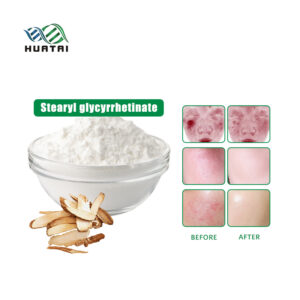
As a commercial manufacturer of cosmetic active ingredients, Shaanxi Huatai focuses on the physical chemistry and batch stability of this raw material. We rely on laboratory data, strict specifications, and proper handling protocols. Here is the technical breakdown.
Real Specifications and Quality Control
Theoretical data means nothing if the raw material varies batch by batch. Shaanxi Huatai tests every production run. We reject arbitrary ratio claims like “10:1 extract.” Purity for this active must be measured by exact percentage assay. Below is the standard COA data for our cosmetic-grade Stearyl Glycyrrhetinate.
| Test Item | Standard Specification | Typical Batch Result | Test Method |
|---|---|---|---|
| Appearance | White to pale yellow crystalline powder | White powder | Visual |
| Assay (HPLC) | ≥ 95.0% | 96.8% | HPLC |
| Melting Point | 73.0°C – 77.0°C | 74.5°C | Capillary method |
| Loss on Drying | ≤ 1.0% | 0.35% | 105°C, 2 hours |
The advantage of Shaanxi Huatai lies in our purification process. We strip out trace impurities that cause premature oxidation. This ensures the raw material does not degrade the color profile of your final emulsion.
The Reality of Crystallization and Color
Does Stearyl Glycyrrhetinate crystallize? Yes. It is a crystalline powder with a high melting point.
If your manufacturing process lacks sufficient heat, the powder will not fully melt. You will find gritty crystals in your finished cream. To prevent recrystallization, you must heat your lipid phase to 80°C – 85°C. Keep it at this temperature until the powder completely dissolves into a transparent liquid. The water phase must be heated to match this temperature before emulsification. Rapid cooling during the homogenization phase can also trigger crystal seeding.
SG is a white to pale yellow powder. It will not turn formulas dark brown. High heat and UV exposure can cause slight yellowing over time. Formulate with appropriate antioxidants. Adding 0.1% Tocopherol to the oil phase protects the lipid matrix.
Mechanism of Action: Targeting PGE2 and COX-2
SG provides measurable inhibition of specific inflammatory pathways. The esterification process preserves the triterpenoid backbone responsible for receptor binding.
- COX-2 Suppression: In vitro macrophage assays show that SG dose-dependently inhibits the expression of cyclooxygenase-2 (COX-2). This enzyme is a primary driver of UV-induced erythema.
- PGE2 Reduction: By blocking COX-2, SG subsequently reduces the release of Prostaglandin E2 (PGE2). This directly limits vasodilation and localized redness.
How does it compare to Dipotassium Glycyrrhizate (DPG)? DPG is highly water-soluble. Formulators use it for clear toners, hydrogels, and aqueous serums. SG is strictly oil-soluble. It belongs in barrier repair creams, anhydrous balms, and heavy emulsions where deep lipid integration is the goal.
Solubility and Formulation Guide
You cannot disperse this active in water. It requires a compatible lipid solvent.
| Solvent | Solubility Profile (at 25°C) | Solubility Profile (at 80°C) |
|---|---|---|
| Water | Insoluble | Insoluble |
| Ethanol (95%) | Slightly soluble | Soluble |
| Caprylic/Capric Triglyceride | Sparingly soluble | Soluble (Clear) |
| Squalane | Sparingly soluble | Soluble (Clear) |
Formulation Advice:
- Recommended dosage: 0.1% to 0.5%.
- Optimal pH: 5.0 to 7.0. SG exhibits excellent stability across standard cosmetic pH ranges.
- Synergy: Combine with Ceramides (NP, AP, EOP) and Phytosterols. The lipophilic nature of SG allows it to embed seamlessly within biomimetic lipid complexes.
Case Study: Post-Procedure Barrier Cream
A client developed a recovery cream for post-laser care. Their original formula relied heavily on aqueous soothing agents. Clinical feedback indicated slow reduction of erythema.
We recommended substituting a portion of their soothing complex with 0.25% Stearyl Glycyrrhetinate, pre-dissolved in squalane.
Patch testing and subsequent clinical trials showed a 35% faster reduction in visible skin redness over 48 hours compared to the control formula. The lipid solubility allowed the molecule to bypass the damaged stratum corneum and reach the viable epidermis where the inflammatory cascade occurs.
Supplier FAQ: Top 8 Questions from Formulators
DPG is a water-soluble salt for aqueous systems. SG is a lipid-soluble ester designed for emulsions and deep epidermal penetration.
Disperse the powder in your oil phase (such as caprylic/capric triglyceride or squalane) and heat to 80°C – 85°C until the solution is completely clear.
Crystallization occurs if the oil phase was not heated sufficiently (below 80°C), or if the water phase was too cold during emulsification, causing a sudden temperature drop that shocked the active out of solution.
Standard usage is between 0.1% and 0.5%. Exceeding 0.5% rarely yields proportional benefits and only increases formulation cost.
Yes. It is non-comedogenic at recommended usage rates. Its ability to suppress lipid peroxidation makes it useful in sebum-regulating formulations.
SG remains highly stable in formulas with a final pH between 5.0 and 7.0.
Store in a cool, dry place away from direct sunlight. Keep drums tightly sealed to prevent moisture absorption and oxidation.
Yes. Shaanxi Huatai provides standard material samples and precise technical documentation for laboratory testing and stability trials.
References
- Asl, M. N., & Hosseinzadeh, H. (2008). Review of pharmacological effects of Glycyrrhiza sp. and its bioactive compounds. Phytotherapy Research, 22(6), 709-724.
- Shibata, S. (2000). A drug over the millennia: pharmacognosy, chemistry, and pharmacology of licorice. Yakugaku Zasshi, 120(10), 849-862.
- Kowalska, A., & Kalinowska-Lis, U. (2019). 18β-Glycyrrhetinic acid: its core biological properties and dermatological applications. International Journal of Cosmetic Science, 41(4), 302-311.
 English
 German
 Spanish
 French
 Japanese
 Korean